NY State Goon Squads
It has a name. That is the part people keep missing.
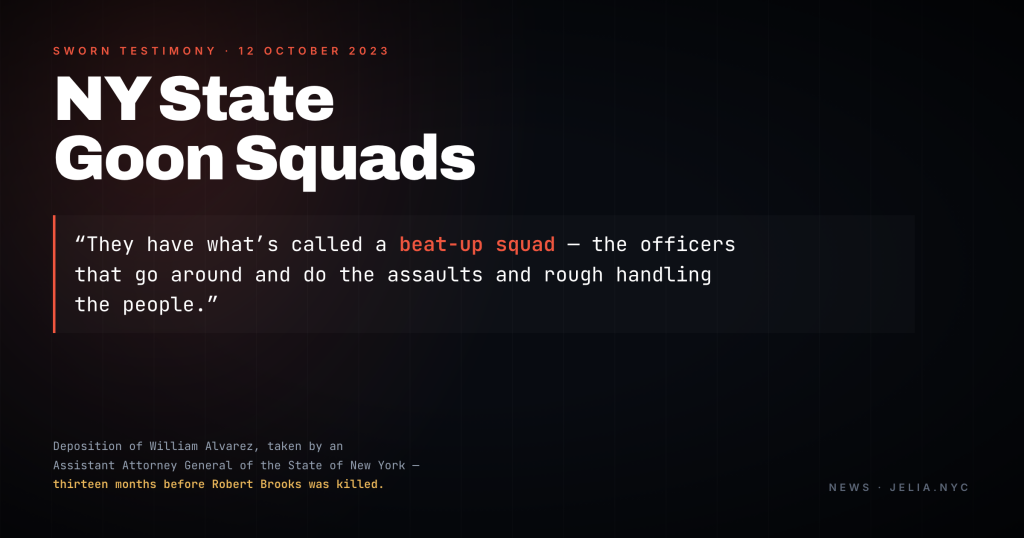
Not a metaphor, not a figure of speech invented by angry prisoners — a name, used inside the walls, understood by everyone who works there. On 12 October 2023, a man named William Alvarez sat for a sworn deposition in his federal civil rights case and explained it to a lawyer from the New York State Attorney General’s office:
“They have what’s called a beat-up squad — the officers that go around and do the assaults and rough handling the people.”
He named the man in charge: Sergeant Glenn Trombly. He testified that as they beat, kicked and choked him in 2020, they told him “they were going to kill me,” and that “there was nothing anybody can do about it.”
Fourteen months later, at the same facility, the same squad beat Robert Brooks to death while he sat handcuffed on a medical examination table.
What a beat-up squad actually is
Every prison in New York has a legitimate emergency response unit. It exists for riots, for hostage situations, for the genuinely dangerous minutes that occasionally happen in a facility holding hundreds of people against their will. It is staffed, as reporting on Marcy put it, with the physically largest guards in the building, or the most aggressive.
That is the lawful structure. The beat-up squad is what that structure becomes when it stops waiting for an emergency.
And this needs saying plainly, because the entire institutional culture depends on blurring it: none of this is anybody’s job. A correction officer is employed to keep people in custody secure and alive. There is no provision in the job description, no module in the training, no line in the Correction Law and no order from any superintendent that authorises a standing crew to administer beatings. Every incident described below is a crime, committed on the State’s payroll, in the State’s building, in the State’s uniform, under colour of the State’s authority.
The roster
According to Alvarez’s sworn testimony and subsequent reporting, the Marcy squad included Sgt. Glenn Trombly as the sergeant in charge, together with correction officers Anthony Farina, Nicholas Anzalone, David Kingsley, Robert Kessler and Christopher Walrath.
Every single one of those six men has since been convicted in connection with the killing of Robert Brooks.
The State was told. Under oath. In writing.
Here is the fact that should end every official’s claim that Marcy was a shock.
Alvarez gave that testimony in a deposition in his 2022 federal civil rights lawsuit — a lawsuit that named Trombly and Farina as defendants. He gave it to Assistant Attorney General Mathew Gallagher. Because in that case, the Attorney General’s office was not investigating Trombly and Farina.
It was representing them. The office assigned three lawyers to their defence.
So on 12 October 2023, the legal office of the State of New York took possession of sworn testimony describing an organised crew of its own employees who beat prisoners, naming its leader and naming its members — thirteen months before that crew killed Robert Brooks. The office that would later prosecute these men was, at that moment, their lawyer.
After Brooks died, the Attorney General’s office moved to withdraw as defence counsel in four pending federal cases involving prisoner-abuse allegations, including one against Farina.
What the squad did before Robert Brooks
Two federal lawsuits describe the same facility in the same year. Both remain allegations by the men who filed them; neither produced a criminal conviction at the time.
Adam Bauer, February 2020. Bauer, serving time for a non-violent drug offence, alleges Officer Antonio Iodice attacked him without provocation in a bathroom, punching his head and kicking him after throwing him to the floor. Officers including Nicholas Anzalone, Sgt. Alfred Zeina and Sgt. Thomas McNaney are alleged to have joined in or failed to intervene. A sergeant allegedly struck his head with a clipboard hard enough to open a v-shaped gash. The beating is alleged to have continued in the van carrying him to the infirmary. He needed more than twenty stitches at St. Luke’s Hospital in Utica.
William Alvarez, 2020. Alvarez alleges Officer Caleb Bause sprayed him with a chemical agent unprovoked in a bathroom, then falsely claimed he had been attacked in order to summon backup. Officer Skyler Tuttle is alleged to have slammed his head into walls and handcuffed him, after which he was kicked on the floor. Trombly and Farina were named as defendants. Alvarez was left with a facial deformity requiring surgery.
One detail from the Alvarez account is worth holding onto, because it tells you precisely what kind of organisation this was: the beating stopped when Trombly said “that’s enough.”
It stopped when the sergeant decided it stopped. That is not chaos. That is command.
Three months after Brooks, they did it again
On 1 March 2025, Messiah Nantwi, 22, from Harlem, was beaten by correction officers at Mid-State Correctional Facility. He was awaiting trial. He died that day at Wynn Hospital in Utica.
The details rhyme so precisely they stop being coincidence:
- Mid-State sits in the town of Marcy — the same complex, barely a fence away from where Robert Brooks was killed.
- Wynn Hospital in Utica is the same hospital Robert Brooks was pronounced dead in, eleven weeks earlier.
- The officers who beat him were part of an emergency response team. The legitimate unit. Again.
- It happened during an unauthorised 22-day statewide guard strike that had emptied the prisons of staff and forced the Governor to deploy the National Guard.
Ten officers were charged in an eleven-count indictment. Jonah Levi and Caleb Blair were charged with second-degree murder. Across the fifteen guards implicated, charges included manslaughter, gang assault, conspiracy, tampering with physical evidence and offering a false instrument for filing. Levi was sentenced to 25 years. Thirteen others took plea deals.
Robert Brooks had been dead for eleven weeks, the whole state was watching, the footage was on the news — and it happened again, in the same town, to a 22-year-old who had not been convicted of anything.
None of this started at Marcy
Attica, 9 August 2011. George Williams was taken from his cell by three officers who told him he was going for a urine test. In a darkened day room they beat him. One witness told investigators he saw Williams take at least fifty kicks and a dozen baton strikes.
They broke both his legs. They broke his ribs. They broke his shoulder. They fractured his eye socket.
Keith Swack, Sean Warner and Matthew Rademacher were charged in December 2011 with first-degree gang assault, falsifying records and tampering with evidence. It was the first time in New York history that gang assault charges had been brought against guards for beating a prisoner.
On the eve of trial, all three pleaded guilty to a single misdemeanour count of official misconduct. They served no jail time whatsoever. They agreed to resign.
That was the precedent set for the next generation of officers at every facility in the state: do this, get caught doing this on the record, and the worst realistic outcome is that you have to find another job.
The arithmetic that keeps it running
Data obtained by NY1 under the state’s Freedom of Information Law shows what has happened since.
A prisoner who is beaten in New York has, on those numbers, roughly a one-in-thirty chance of the State agreeing with him afterwards. He is beaten by men who know that number better than he does.
That is not a system that failed to notice a beat-up squad. That is the environment in which a beat-up squad is a rational thing to join.
What actually happened to the squad’s sergeant
Glenn Trombly — named under oath as the sergeant in charge, defendant in the Alvarez suit, present at the death of Robert Brooks — pleaded guilty to offering a false instrument for filing and second-degree reckless endangerment. He did not strike Brooks. He also did not intervene. He testified against the others.
He was sentenced to two consecutive one-year terms in the Oneida County Jail.
Not state prison. County jail. For the man a prisoner had identified to the Attorney General’s own lawyer, thirteen months in advance, as the head of the crew.
The phrase “a few bad apples” requires the apples to be unaware of one another. These men had a roster. They had a sergeant. They had a name for themselves, one that everybody inside knew and used. They had, in Alvarez’s account, a commander who decided when a beating started and when it had gone on long enough.
That is not a few bad apples. That is a unit.
And New York State had it described, under oath, by name, in its own files, thirteen months before it killed Robert Brooks — and did nothing at all.
Sources
- The Free Lance News — “Prison Guard ‘Beat-Up Squad’ Killed Robert Brooks, Operated For Years, Attorney General Letitia James’s Office Knew It”
- CNY Central I-Team — Marcy officers involved in a pattern of abuse and violence, lawsuits show
- Times Union — Attorney General withdrawing from prison abuse lawsuits against Marcy officers
- Killing of Messiah Nantwi — Mid-State Correctional Facility, 1 March 2025
- Corrections1 — Jonah Levi sentenced to 25 years in the Nantwi case
- The Marshall Project — “Attica’s Ghosts” (George Williams, 2011)
- Prison Legal News — Attica guards avoid jail time
- NY1 — How violence skyrocketed in New York state prisons (FOIL data)
- Rome Sentinel — Sgt. Trombly sentenced to county jail
- Correctional Association of New York — monitoring data portal